
Live from Gaza: A Girl Up Youth Leader Shares Her Reality
Trigger warning: The following content includes descriptions of violence and war.
Girl Up leader Reem Z. shares a first-hand account on her situation in Gaza
We are deeply concerned about the safety of youth, women, and civilians in Israel and Palestine amid the escalating violence in the region and deteriorating humanitarian situation in Gaza. We strongly condemn the targeting of civilians and the recent attacks that have killed thousands of innocent Israelis and Palestinians. We echo calls made from across the United Nations for an immediate ceasefire, the release of all hostages, and clear access to humanitarian aid to Gaza now.
This humanitarian crisis impacts the entire Girl Up community and, in alignment with our values as a youth-centered organization, we will continue to amplify youth leaders who reach out to us wishing to share their stories and experiences on our blog. This was the case for Girl Up leader Reem, and she shared her name, identity, and location with us as well as her permission to publish those details and her footage below.
While we review and edit blogs for length and clarity, the views and opinions expressed in each blog represent the writer’s own and do not necessarily reflect the views and opinions of Girl Up. As this blog is a first-person account and the situation is still developing, we cannot guarantee the accuracy of the information shared below.
While we will always prioritize youth-led storytelling, we are taking precautions to protect our leaders involved in any of our communication efforts and will continue to dedicate our platforms to elevating their perspectives safely, ethically, and authentically.
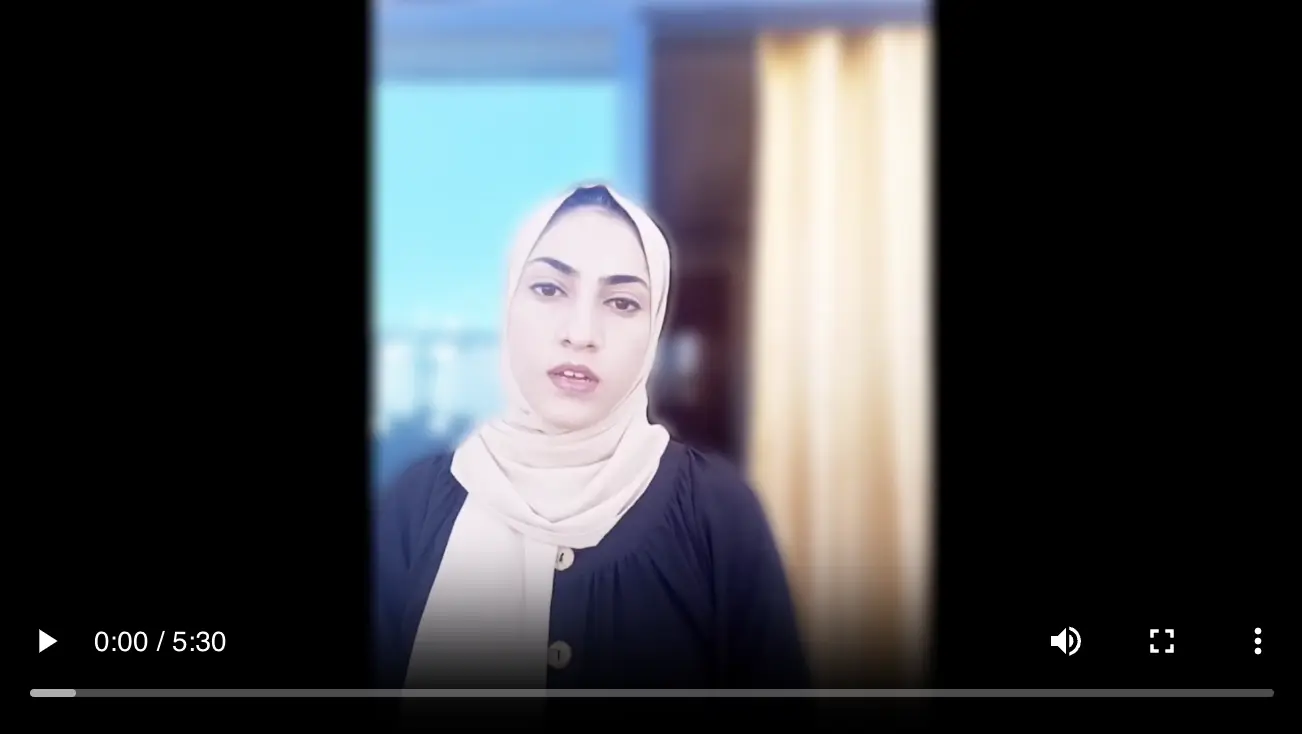
Hello, Girl Up. I'm Reem. I'm 22 years old. I live in Palestine Gaza Strip. I've completed my bachelor's degree in English translation. I graduated last year. I've worked as a volunteer with journalistic agencies and human rights organizations. I'm also a member of the Girl Up Community and a participant of the Girl Up mentorship program, which I didn't have the chance to complete because of the circumstances I live in right now.
The social justice issue that is important for me is education. I think the most important thing women and girls should obtain is education because it enables them to make their own decisions that enables them to build better futures for themselves and their families.
I'm shooting [this video] and you can literally hear the sounds of warplanes. I feel them on the top of my head.
As a Palestinian girl who lives in the Gaza Strip—which is an area cut off from the rest of Palestine since 2007—we have no freedom of movement, we can't travel abroad, no prosperity or any kind of normal life needs, and the most important thing, there is no peace. I'm 22 and I've witnessed five aggressions on the Strip and many more Israeli escalations.
But the amount of loss this aggression has is much more than any escalations we’ve witnessed here in the Strip. You can't imagine what's happening here. If I'm alive now shooting this video, I don't know if I'll be alive a few minutes later. Israeli warplanes are launching rockets everywhere on the Strip. There is no safe place, forcing us to displace our houses and move to what they called a safe area in the south of the Strip, and then they bombed a truck holding people on their way to the south—to what they called safe area—threatening us through phone calls to forcibly displace our houses. The medical system has collapsed. There is no place to treat the injured or to even bury dead people. They are not only killing us one by one, they are killing entire families. They are buried in mass graves. Hospitals are collapsing. There is no safe place.
Throwing white phosphor during this aggression on some areas is not self-defense. This is genocide. We are subjected to no water, no food. Nothing is allowed to enter the Strip because they bombed the Rafah crossing point, which connects Gaza with Egypt. No internet or electricity, and an internet outage led to a lack of communication and news, preventing any aid, medical aid, food, or water to enter the Strip. So, if Palestinians won't die from the war, we will die from hunger.
We live in indescribable fear. This has devastating consequences. Targeting civilians is not self-defense.
The internet connection is very poor so we can't document what's really happening here.
Girls and women are much more affected by this aggression because we'll have to cover our heads and be ready to evacuate the house at any moment. People who already evacuated and sought shelters in hospitals—by the way they bombed a hospital last night [October 17], Al Ahli Hospital, known as The Baptist Hospital, they bombed it. 1,300 people were killed. They sought shelter in this hospital. Women and girls are suffering in hospitals because although hospitals are known as a safe place that can't be bombed, they can be bombed. This is what we saw what live. Women and girls who have to stay in hospitals, we'll have to cover our heads, we'll have to be ready to evacuate our houses. Children are writing their names on their hands so if anything happens and they are killed, they won't be anonymous. Every woman, every girl has lost one of her loved ones.
There is no privacy for women and girls. When they take shelter in someplace, most of the time, her husband and her kids get separated because there is no privacy. Women have to stay in one place and men have to stay in another place.
What can others do to help? Search for the truth about Palestine. Don't let the media fool you and speak up. Don't underestimate the power of your voice. Speak up and make a change to stop this genocide that we are subjected to.
My message to the world: Palestinian victims who were killed during these aggressions, they are not numbers. They have faces, names, dreams, and people who love them, and will never forget them.
This blog was written by a Girl Up youth leader and reflects her personal thoughts and experiences. Girl Up encourages our Community members to raise their voices for issues they care about. Our top priority is the safety, security, and wellbeing of our members in all aspects of the work they do in their communities around the world. If you would like to write for VOICES, please contact [email protected].
For a comprehensive list of resources dedicated to responding to this humanitarian crisis from United Nations agencies, click here.